

LymphaPress for Leg Swelling in Dallas: Lymphedema Care
More than 10 million Americans have a lymphedema diagnosis, and persistent leg swelling deserves careful assessment before compression therapy is considered. LymphaPress for leg swelling in Dallas may be part of lymphedema management: therapy has been shown to stimulate lymph absorption and increase lymph transport in affected legs for at least one hour after a treatment session. It’s a way to support care, not a standalone answer to every cause of swelling.
Living with swollen legs can affect comfort and mobility, so it’s understandable to want a clear picture of what treatment involves. This article explains how pneumatic compression works, why assessing the cause of swelling matters, and what patients have reported, including feeling lighter or walking more easily. You’ll also learn what professional treatment may involve and which considerations help determine whether LymphaPress fits into an individual lymphedema management plan.
Table of Contents
Lymphedema management
Leg swelling can have causes besides lymphedema, so assessment comes before pneumatic compression. More than 10 million Americans have a lymphedema diagnosis. A clinician evaluates the swelling’s cause and considers whether compression belongs in the care plan. This distinction matters because a device can support lymphatic care but cannot identify why a leg is swollen.
UT Southwestern describes lymphedema as progressing through four stages. At stage 0, the affected area may feel tight or heavy without visible swelling. At stage 1, swelling may return to normal after elevation. Stage 2 swelling is present most of the time, and the skin can feel more rigid. In stage 3, the area may be extremely swollen, with changes in skin color or texture. UT Southwestern also says lymphedema cannot be cured, but its symptoms can be managed.
Does professional LymphaPress treatment require a prescription or medical assessment? A medical assessment is important before compression is considered, because leg swelling needs to be evaluated for its cause. A licensed medical practitioner prescribes the pressure, cycle time, and other settings for leg compression pump treatment.
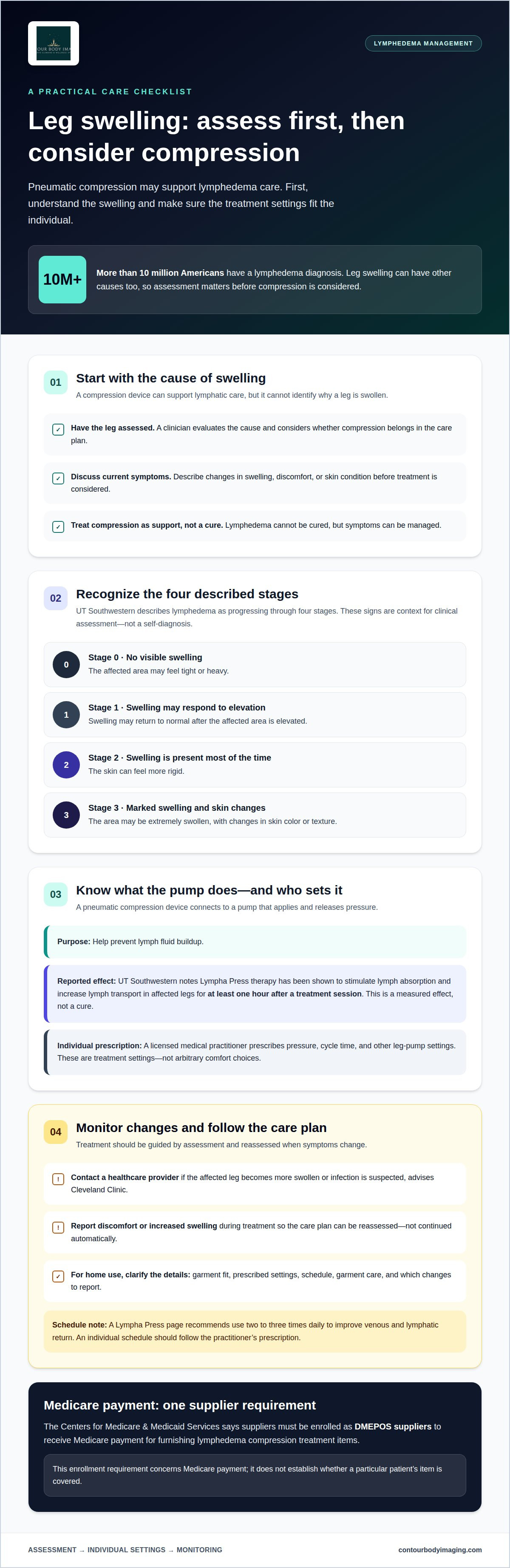
A compression device connects to a pump that applies and releases pressure to help prevent lymph fluid buildup. UT Southwestern notes that Lympha Press therapy has been shown to stimulate lymph absorption and increase lymph transport in affected legs for at least one hour after a session. This is a measured effect, not a cure. Pressure and timing are treatment settings, not arbitrary comfort choices.
What about insurance or Medicare coverage? The Centers for Medicare & Medicaid Services says suppliers must be enrolled as DMEPOS suppliers to receive Medicare payment for furnishing lymphedema compression treatment items. This enrollment requirement concerns Medicare payment; it does not establish whether a particular patient’s item is covered.
How can a clinician assess risks, contraindications, and side effects? The clinician first evaluates the swelling’s cause and the leg’s current symptoms before considering compression. Patients should describe changes during treatment, including discomfort or increased swelling, so the care plan can be reassessed rather than continued automatically.
For home use, the clinician can explain how the prescribed garment fits, which settings apply, and how the schedule follows the care plan. A page about Lympha Press recommends use two to three times daily to improve venous and lymphatic return; an individual schedule should follow the practitioner’s prescription. Ask for clear instructions on garment care and which changes to report.
When should swelling be evaluated promptly instead of treated with compression? Contact a healthcare provider if the affected leg becomes more swollen or infection is suspected, advises Cleveland Clinic. A sudden change or new skin concern warrants attention before another compression session, because assessment should guide the next step.
Patient experiences
Individual accounts describe different changes during Lympha Press use. Nadia B. says her legs improve after each treatment and feel lighter and more flexible. Merle S. reports walking more easily after using a pump on her legs. These descriptions reflect personal sensations and movement, not a standard outcome for every patient. They can help readers identify what matters to them, such as comfort, mobility, or how heavy their legs feel.
Several accounts focus on visible swelling. Maxine S. of Katy, Texas, says she used a pump three times a day to help control leg swelling and pain. Peggy K. of Frisco, Texas, reports that a pump controlled swelling in her leg and seemed to help her wound heal. Maxine M. of West Columbia, South Carolina, describes reduced leg swelling alongside improving circulation. These are individual reports, not a substitute for clinical measurement or a treatment plan.
Comfort also features in patient descriptions. Paul S. of Venice, Florida, calls the compression pump comfortable and says it keeps his legs from swelling. Norma T. of Jonesboro, Arkansas, reports less fluid and swelling, with less pain than she experienced from compression bandages. Her comparison illustrates that treatment experience can depend on both the pressure sensation and how it feels relative to another method. Comfort is personal, so one account cannot predict another person’s response.
Some stories describe changes over a specific period. One user reports improved veins in both legs after one month of device use. Another Lympha Press user from Tyler, Texas, says she lost 12 inches during her first week with the Lympha Jacket and Lympha Pants. Penny P. shares that her routine brought noticeable changes in her daily comfort when managing LymphaPress for legs swelling Dallas. These accounts involve different people, garments, and outcomes; inches or weight changes should not be treated as expected lymphedema results.
Other accounts involve treatment alongside additional care. Nancy R. of Waller, Texas, says she was diagnosed with breast cancer in November 2013 and had lymph node surgery in November 2020. She reports that her arm became smaller after using a pump and physical therapy. Her experience concerns arm swelling, not leg swelling, and includes more than one form of care. It shows why each story’s body area and treatment context matter.
For Dallas readers considering compression care, these accounts offer examples of what some users notice, including comfort, swelling, pain, flexibility, and walking. They don’t establish what any particular patient will experience. A useful discussion with a clinician can focus on personal treatment goals and how progress will be assessed, rather than relying on another patient’s measurements or timeline.
Margaret P. of Palestine, Texas, reports that the equipment reduced swelling she had experienced throughout her life. Miriam P. says a Lympha Press pump helps her legs and that the company arranged it within a few weeks.
Marilyn W. reports that Lympha Press helped her leg lymphedema and made her leg and ankle feel better. These accounts offer further personal perspectives, but they are not a guarantee of what another user will experience.
How can a clinician help determine which LymphaPress devices are designed for legs and lymphedema?
A clinician can match a leg garment to the area requiring compression and the prescribed treatment plan. Lympha Press leg sleeves are designed to treat the entire leg, foot, and ankle. Their configurations include either 4 or 8 chambers. Those options describe garment construction, not a promise that one design will work better for every person. The affected areas and prescribed settings guide the discussion.
Coverage matters when swelling extends beyond one part of the leg. For example, a clinician can consider whether the garment needs to address the foot and ankle along with the leg. The Lympha Pants™ lower-body garment offers 24 chambers and XL sizes. Its lower-body design differs from a leg sleeve, so the relevant coverage area helps clarify which garment to consider.
Pump compatibility is another practical point. The Lympha Press® 12 Chamber FL Leg Garment works with the Optimal Plus and Mini Press™ pumps. A clinician can compare that pairing with the patient’s prescribed plan and intended garment coverage. Naming a compatible pump does not establish that a particular setup is appropriate; pressure, cycle time, and other treatment settings remain prescribed by a licensed medical practitioner.
The PCD-51 and PCD-52 have different listed features. The PCD-51 can treat two limbs simultaneously and has adjustable pressure and time settings. The PCD-52 includes a battery for portability. These distinctions can help a clinician discuss how a device’s design relates to the treatment plan and practical use. They do not replace assessment of the swelling or determine the correct garment by themselves.
A focused device discussion can cover these points:
Area: Does treatment need to cover the foot, ankle, entire leg, or lower body?
Garment: Would a 4- or 8-chamber sleeve, Lympha Pants™, or the 12 Chamber FL Leg Garment address the prescribed area?
Pump: Is the garment compatible with the pump being considered, such as the FL garment with Optimal Plus or Mini Press™?
Settings: Which pressure and cycle time did the licensed practitioner prescribe?
For someone comparing Lympha Press options for leg swelling in Dallas, these model distinctions provide useful questions for a clinical conversation. A 24-chamber lower-body garment, a full-leg sleeve, and a two-limb pump feature describe different design considerations. The clinician’s role is to connect those details to the affected areas and prescribed treatment, rather than choosing by chamber count or portability alone.
Where can I get professional guidance on obtaining a LymphaPress device in Dallas, Texas?
Start with a medical assessment of the leg swelling. A clinician evaluates its cause before pneumatic compression is considered. If treatment is appropriate, a licensed medical practitioner prescribes the pressure, cycle time, and other settings. That prescription helps define the treatment plan; it does not, by itself, identify a supplier or establish payment coverage.
In Dallas, UT Southwestern lists Vascular Medicine at West Campus Building 3, 2001 Inwood Road, 5th Floor, Dallas, Texas 75235. It also lists William P. Clements Jr. University Hospital at 6201 Harry Hines Blvd., Dallas, Texas 75235. These are listed medical locations, not confirmation that either supplies a particular device. The relevant first step remains an assessment of the swelling.
Keep the clinical decision separate from the equipment and payment process. A medical practitioner determines whether compression belongs in the care plan and sets treatment parameters. The equipment pathway concerns the prescribed item and its supplier. For Medicare payment, the Centers for Medicare & Medicaid Services requires a supplier to be enrolled as a DMEPOS supplier to receive payment for furnishing lymphedema compression treatment items.
That enrollment condition applies to supplier payment under Medicare. It does not establish that every patient qualifies for coverage or that every device is covered. For a practical discussion, clarify the prescribed garment and pump, the intended treatment area, and who handles the equipment transaction. These details help align the clinical plan with the acquisition steps.
A useful professional guidance conversation can address:
Assessment: What cause of leg swelling is being evaluated, and is compression appropriate?
Prescription: Which pressure, cycle time, and other treatment settings apply?
Equipment: Which garment and pump fit the prescribed treatment area?
Payment process: If Medicare payment is involved, is the furnishing supplier enrolled as a DMEPOS supplier?
Follow-up: What changes in swelling or skin condition should prompt another clinical review?
Patients in Dallas can use these points to connect a medical assessment with the next equipment steps. A device decision should follow the clinical plan, not replace an evaluation of swelling. This distinction is especially useful when the cause has not yet been established or an existing treatment plan needs updated settings.
For LymphaPress guidance in Dallas, the professional roles are clear: a clinician assesses the swelling, a licensed medical practitioner prescribes treatment settings, and the supplier handles the equipment process. UT Southwestern’s listed locations provide local reference points for medical care, while the Medicare supplier requirement applies specifically to payment for covered compression items.
Which Dallas clinics or therapists provide LymphaPress treatment for leg swelling?
Finding professional help starts with separating medical assessment from equipment supply. A clinician evaluates the cause of leg swelling, while a licensed medical practitioner prescribes compression settings. These roles matter because swelling can have different causes, and treatment decisions should follow assessment. A clinic’s specialty or Dallas address alone doesn’t establish that it provides a particular device or treatment.
UT Southwestern lists Vascular Medicine at West Campus Building 3, 2001 Inwood Road, 5th Floor, Dallas, Texas 75235. It also lists William P. Clements Jr. University Hospital at 6201 Harry Hines Blvd., Dallas, Texas 75235. These locations give readers specific Dallas reference points for medical care. The listing names locations, not a particular compression service.
For treatment planning, focus on the practitioner’s role. A licensed medical practitioner prescribes pressure, cycle time, and other settings for leg compression pump treatment. A clinician assesses the cause of swelling before compression is considered. This sequence distinguishes a medical treatment plan from simply obtaining equipment and clarifies who handles assessment and device supply.
Equipment acquisition can involve a separate supplier. For Medicare payment, the Centers for Medicare & Medicaid Services says a supplier must be enrolled as a DMEPOS supplier to receive payment for furnishing lymphedema compression treatment items. This requirement concerns supplier enrollment for Medicare payment. It doesn’t identify a Dallas clinic as a supplier or establish coverage for every patient.
As you clarify the right local pathway, keep these roles distinct:
Clinical assessment: A clinician evaluates the cause of leg swelling.
Prescription: A licensed medical practitioner sets pressure, cycle time, and other treatment parameters.
Device supply: A supplier handles furnishing the prescribed compression item.
Medicare payment: CMS enrollment applies to suppliers seeking Medicare payment for these items.
For someone in Dallas, the practical next step is to identify which role they need first. A person without an assessment needs clinical evaluation. Someone with prescribed settings can focus on the equipment pathway and applicable payment process. If the leg becomes more swollen or infection is suspected, Cleveland Clinic advises contacting a healthcare provider rather than treating the change as a routine device question.
Clear role distinctions make local care easier to navigate. UT Southwestern’s listed addresses identify medical locations, while the prescribing practitioner determines treatment settings. CMS enrollment relates to Medicare payment for suppliers. Keeping these roles separate helps patients discuss care and equipment without mistaking a hospital listing for a specific treatment service.
Venous stasis ulcers may be relevant when discussing treatment: without treatment, they may persist for months or even years. In a study of Lympha Press PCD51 treatment for chronic venous stasis ulcers, most patients experienced complete wound healing within eight weeks. That study result does not guarantee an individual outcome.
The page reports that 0% of Lympha Press patients remained compliant with treatment during their first two years of use. This figure and the study result describe different reported outcomes; neither identifies a Dallas clinic or therapist providing treatment. Patients can confirm service availability and discuss whether prescribed compression is appropriate with their clinician.
Contour Body Imaging: LymphaPress
Contour Body Imaging offers LymphaPress as part of its wellness treatment menu for lymphatic drainage. If a clinician has recommended compression therapy for leg swelling, LymphaPress may be a relevant option to discuss alongside your care plan. It does not replace assessment of the swelling or treatment settings prescribed by a licensed medical practitioner.
Before considering a session, keep your clinical guidance and wellness goals clear. Share relevant instructions about compression settings and treatment areas so the conversation can focus on how LymphaPress fits your needs. If swelling worsens or you suspect infection, contact a healthcare provider for medical evaluation rather than relying on a wellness treatment.
For a calm conversation about LymphaPress and your goals, contact Contour Body Imaging.
Choose a thoughtful next step for leg swelling
Let your next step build on what matters most in daily life. You might want to move more comfortably, understand a treatment option, or have a clearer conversation about ongoing care. Discussing LymphaPress for leg swelling in Dallas can keep the focus on your needs, not someone else’s experience. Whether compression is appropriate depends on your individual care plan.
Consider what you want to understand before moving forward: how a treatment may fit alongside existing care, what changes you hope to monitor, and which questions remain unanswered. A calm, informed conversation can help you decide what feels appropriate and what belongs with your medical practitioner. There’s no need to rush; a considered next step is valuable in itself.
Keep taking your care one clear decision at a time. Your questions are a constructive place to begin.
Frequently Asked Questions
What is LymphaPress and how does it help leg swelling?
LymphaPress is a pneumatic compression system that uses a pump and garment to apply and release pressure. This rhythmic pressure can help limit lymph fluid buildup; therapy has also been shown to stimulate lymph absorption and increase lymph transport in affected legs for at least one hour after a session. For a practical discussion, focus on which leg areas need support and how changes in comfort or swelling will be monitored.
How do LymphaPress and other pneumatic compression devices compare for leg swelling?
LymphaPress is one option within pneumatic compression, where a pump applies and releases pressure through a garment. Compare options by considering the treated area, garment coverage, pump functions, and settings prescribed for the individual, rather than assuming one device is best. For example, a leg-focused sleeve and a lower-body garment cover different areas. A clinician can relate those design differences to the treatment plan.
What are the risks, contraindications, and side effects of LymphaPress leg compression?
A clinician should assess the cause of leg swelling and current symptoms before compression is considered. Report discomfort or increased swelling during treatment, and contact a healthcare provider if the leg becomes more swollen or infection is suspected.

Comments