

LymphaPress for Water Retention: Treatment Time and Results
The treatment schedule matters as much as the device. For lymphedema-related swelling, LymphaPress for water retention is usually used for one or two hour-long sessions per day, as prescribed by a licensed medical practitioner. Because plans differ, another person’s schedule may not suit your needs.
It’s understandable to want to know how soon swelling might change and how much time treatment takes. Patient reports describe varied experiences, while clinical evidence offers a broader view of what compression therapy may do. This article explores reported results, treatment schedules, and evidence related to LymphaPress for water retention, helping you understand what to discuss with a healthcare professional.
Table of Contents
Patient experiences and treatment compliance
Patient reports describe changes in swelling, discomfort, and daily activity, but experiences vary. One LymphaPress user noticed a difference in leg size after 20 minutes. Another reported that swelling had nearly returned to normal after one month of daily treatments. These are individual accounts, not timelines that predict another person’s results.
Survey findings offer a broader snapshot of reported experiences. The Center for Opinion Research at Franklin and Marshall College surveyed 800 patients prescribed a pneumatic compression device. Among those surveyed, 83% said their leg condition improved, and 85% said the device reduced discomfort. Another survey found that 94% would recommend it to someone with a similar condition. These responses describe patient opinions, not a guaranteed clinical outcome.
Accounts also show how treatment may fit into everyday life. One patient described using a compression pump two or three times daily, with each session lasting one hour. Another reported daily walking increasing from about 1,000 steps to about 4,000 steps while using a pump. Such examples can help readers understand reported routines, but they don’t establish that treatment caused every change.
Some testimonials describe notable changes. One Lympha Press user reported losing 12 inches during the first week with a Lympha Jacket and Lympha Pants. Another said twice-daily pump use reduced leg size almost by half. These striking personal accounts shouldn’t be treated as expected results. The reported outcomes differ, and testimonials don’t replace a clinician’s assessment.
Longer-term use also appears in patient experience reports. In a study of Veterans Administration patients using Lympha Press, 87% were still using the device as prescribed after two years. That figure speaks to continued use in that group, not effectiveness for every person. Lympha Press advises patients to consult their practitioner before changing treatment when swelling reduces.
How does LymphaPress compare with other pneumatic compression pumps for edema? Patient reports don’t establish that it works better than other pumps. They describe experiences with a particular device, while treatment plans and individual responses differ.
When reviewing personal stories, focus on the specific outcome and its context:
Note whether the report concerns swelling, pain, movement, or another change.
Look for the treatment routine described, such as daily use or session length.
Separate an individual testimonial from survey results across a patient group.
Discuss reduced swelling with the treating practitioner before changing the prescribed routine.
These distinctions make patient experiences useful without overstating them. For example, a reported change after 20 minutes offers a personal observation, while the two-year adherence figure describes continued use. Neither alone tells you what result to expect. Together, patient reports and survey responses can help frame realistic questions about comfort, routine, and measurable changes to discuss with a healthcare professional.
Recommended treatment frequency and duration
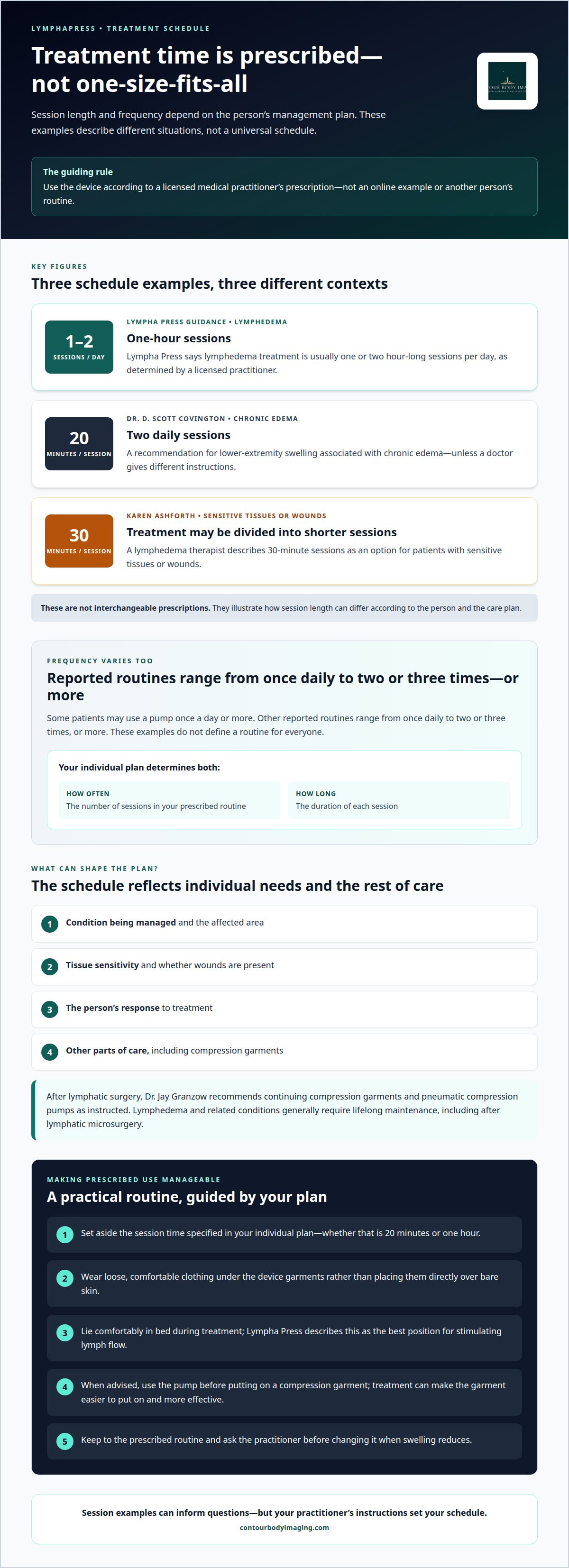
There isn’t one schedule for everyone using a pneumatic compression pump. Lympha Press says lymphedema treatment is usually one or two hour-long sessions per day. A licensed medical practitioner determines the routine as part of the person’s management plan. Follow that prescription rather than adopting a schedule from someone else’s story.
Other recommendations describe different situations, not a single universal rule. Dr. D. Scott Covington recommends two daily, 20-minute lymphatic pump sessions for lower-extremity swelling associated with chronic edema, unless a doctor gives different instructions. Lymphedema therapist Karen Ashforth says treatment can be divided into 30-minute sessions for patients with sensitive tissues or wounds. These examples illustrate how session length may change with the person’s needs.
Frequency can vary, too. Karen Ashforth says some patients may use a pump once a day or more. Other reported routines range from once daily to two or three times, or more. Lympha Press treatment frequency and session duration depend on the individual lymphedema management plan. Use the device according to a licensed practitioner’s prescription, not an online example.
Why do schedules differ? The plan accounts for the condition being managed, the affected area, tissue sensitivity, wounds, and the person’s response. A practitioner may also consider how pump sessions fit alongside compression garments and other parts of care. After lymphatic surgery, Dr. Jay Granzow recommends continuing compression garments and pneumatic compression pumps as instructed. Lymphedema and related conditions generally require lifelong maintenance, including after lymphatic microsurgery.
Practical details can make prescribed use easier to follow:
Set aside the session time specified in the individual plan, whether it is 20 minutes or one hour.
Wear loose, comfortable clothing under the device garments, rather than placing them directly over bare skin.
Lie comfortably in bed during treatment; Lympha Press describes this as the best position for stimulating lymph flow.
Use the pump before putting on a compression garment when advised, since treatment can make the garment easier to put on and more effective.
Keep the routine consistent, and ask the practitioner before changing it when swelling reduces.
These steps support a manageable routine without turning another person’s schedule into your own. For example, a 30-minute session may suit someone whose tissues are sensitive, while another person’s prescribed plan may call for longer sessions. The deciding guide remains the practitioner’s instructions and the individual management plan. Record session duration and any changes in comfort or swelling to discuss during care reviews.
The page recommends using Lympha Press two to three times daily to improve venous and lymphatic return. Some people use a Lympha Press device once a day, while others use it two to three times or more.
Clinical studies and evidence
Clinical evidence helps distinguish measurable findings from personal accounts. Compression therapy applies rhythmic pressure to support fluid movement from affected areas. Studies examine specific conditions and outcomes, so results for one condition may not predict results for another.
More than 30 medical studies support Lympha Press compression therapy. That total indicates a body of research, but it doesn’t mean every study tests water retention broadly. Study design, participant condition, treatment protocol, and measured outcome all affect what findings can show.
Research has shown increased lymph absorption and transport in affected legs during treatment. This effect continued for at least one hour after a session ended. The finding describes fluid transport, not a guaranteed visible change in swelling or a cure for its underlying cause.
Other evidence concerns chronic venous stasis ulcers, a particular wound condition. In a study using the PCD51 system, most patients experienced complete wound healing within eight weeks. A separate study focused on ulcers resistant to other available treatments. All patients treated with that system experienced wound healing. These results apply to the studied ulcers and protocols, not every type of edema.
Regular use may also help prevent recurrent cellulitis in people with lymphedema. Cellulitis associated with lymphedema swelling requires urgent medical treatment. Compression therapy should be part of appropriate care, not a substitute for urgent assessment when infection occurs.
Lympha Press Optimal Plus is cleared by the FDA for treating lipedema in the United States. Clearance for that condition doesn’t establish that every device or treatment plan suits every cause of fluid retention. Diagnosis matters because swelling can have different causes.
Do you need a prescription or clinician evaluation to use LymphaPress in the United States? Yes. A doctor’s order is required to obtain Lympha Press medical-device therapy systems.
Where can you get LymphaPress in the United States, including clinics and authorized suppliers? Access begins with a prescribing clinician’s order, then proceeds through clinics or medical equipment suppliers involved in prescribed care. This process connects device use with a documented diagnosis and treatment plan.
To interpret a study or discuss its relevance, focus on these details:
Check which condition researchers studied, such as lipedema or venous ulcers.
Identify the outcome measured, including fluid transport, wound healing, or infection recurrence.
Note the device and treatment protocol, since findings may apply to specific systems.
Discuss how the evidence relates to your diagnosis and prescribed care plan.
These distinctions keep the evidence useful and specific. For example, increased lymph transport supports a possible mechanism, while ulcer-healing results concern a defined wound population. Neither finding alone predicts an individual’s outcome. A clinician can interpret the evidence alongside the cause of swelling, symptoms, and treatment goals.
What medical conditions can cause water retention that LymphaPress may not treat?
Water retention describes a symptom, not its cause. A compression pump applies rhythmic pressure to help move fluid from swollen areas. It doesn’t diagnose why fluid accumulated or treat every underlying medical problem. This distinction matters when swelling affects more than one area or keeps returning.
Some chronic swelling is associated with lymphedema, lipedema, post-amputation swelling, post-surgical swelling, or venous disease. Compression devices may be part of a broader management program for these conditions. That doesn’t mean a device treats the condition itself, removes its cause, or suits everyone with the diagnosis. The care plan must match the reason for swelling.
Other forms of water retention may stem from problems affecting fluid balance throughout the body, rather than a local lymphatic or venous pathway. A leg pump cannot identify or correct those underlying problems. For example, swelling in both legs alongside swelling elsewhere calls for medical assessment of the overall pattern, not an assumption that local compression addresses the cause.
Consider the difference between a local and a broader pattern. One ankle that swells after surgery differs from swelling in both legs that appears alongside other changes. Surgery-related swelling is among the conditions included in compression-device management programs. A broader pattern still requires assessment, because the same visible symptom can have different causes and care needs.
People with edema should consult a doctor before using a compression pump. The clinician considers the location and timing of swelling, relevant diagnoses, and whether the intended treatment fits the underlying problem. A clear diagnosis helps distinguish chronic lymphatic or venous swelling from retention that needs another form of medical care. A pump is one possible component, not a substitute for that assessment.
Use this sequence to keep the decision focused:
Describe where swelling appears, such as one leg, both legs, or several areas.
Note when it began and whether surgery or another known condition preceded it.
Share other symptoms and existing diagnoses during the medical evaluation.
Ask whether compression belongs in the plan for the identified cause.
Cellulitis associated with lymphedema swelling requires urgent medical treatment. Compression use should not delay urgent care. A clinician can determine the next steps and how swelling management fits afterward.
The key question isn’t simply whether fluid is present. It’s whether the cause and location of swelling match a treatment plan that uses compression. Lymphedema, lipedema, venous disease, and swelling after surgery or amputation are among the conditions managed with compression devices. Broader fluid-retention patterns need medical evaluation before assuming a pump will address them. This distinction helps prevent a device from being mistaken for treatment of an undiagnosed cause.
What are the risks and contraindications of using LymphaPress compression devices?
Compression applies rhythmic pressure to help move fluid from swollen areas. Because edema can have different causes, using a pump without medical guidance may address the swelling while missing its underlying cause. People with edema should consult a doctor before starting compression-pump use. This evaluation helps determine whether compression fits the person’s condition and care plan.
Start with the underlying diagnosis. Lymphedema, lipedema, venous disease, and swelling after surgery or amputation may be managed with compression devices. That doesn’t mean every cause of fluid retention responds to compression. A doctor can consider where swelling occurs, its history, and other diagnoses before recommending an approach. This step matters especially when swelling has appeared recently or changed.
Cellulitis linked to lymphedema swelling requires urgent medical treatment. A compression session must not delay care. If a person with lymphedema develops cellulitis, the priority is urgent medical attention, not trying to manage the episode with a pump. Keeping this distinction clear helps ensure a device doesn’t replace necessary treatment.
Prescribed use matters, too. Lympha Press advises patients to follow their licensed medical practitioner’s prescription. Treatment frequency and session length depend on the individual management plan. Don’t copy another person’s schedule or change your routine simply because swelling looks different. If swelling reduces, consult the practitioner before changing the program.
A personalized setup is another practical safeguard. A Lympha Press technician adjusts device pressure and inflation patterns to meet individual treatment needs. The treatment plan and device settings should work together, rather than relying on settings chosen without guidance. Share relevant changes in swelling or comfort with the practitioner overseeing care. Those details can inform decisions about the plan.
Before treatment, use these steps to support safer decisions:
Discuss edema with a doctor before beginning pump use.
Share relevant diagnoses, including lymphedema or venous disease.
Follow the prescribed schedule and avoid changing it independently.
Seek urgent medical treatment for cellulitis associated with lymphedema swelling.
Raise changes in swelling or comfort with the practitioner managing care.
These steps distinguish routine swelling management from situations that need prompt medical attention. For example, reduced swelling may prompt questions about the schedule, while cellulitis requires urgent treatment. A pump is one part of a broader plan, not a tool for diagnosing the cause of edema. Medical guidance, an individualized setup, and the prescribed routine help keep its use aligned with the person’s needs.
A reviewer reported having lymph node surgery in November 2020 to transfer lymph nodes from her leg to her underarm. This is an individual history, not a basis for assuming that another person’s swelling has the same cause or that the same approach is suitable. Surgical history can be shared with the practitioner during assessment, alongside changes in swelling and comfort. Device use and settings should still follow the person’s own prescribed plan, with concerns or changes discussed with the practitioner rather than used as a reason to adjust treatment independently.
Contour Body Imaging: LymphaPress
Contour Body Imaging offers LymphaPress Lymphatic Drainage as part of its wellness treatment menu. If you’re exploring compression therapy for swelling, this may be a next step after discussing the cause and appropriate care with your healthcare practitioner. Medical-device therapy systems require a doctor’s order, and treatment should follow the prescribed plan.
LymphaPress uses compression to support fluid movement, while the right approach depends on your health needs and practitioner’s guidance. A conversation with Contour Body Imaging can help you understand how its LymphaPress offering fits your wellness goals. Contact Contour Body Imaging to discuss LymphaPress.
Make your next step a considered one
Before choosing LymphaPress for water retention, consider how it fits your health needs and wellness goals. A conversation with your healthcare practitioner can clarify the medical side, while Contour Body Imaging can discuss its LymphaPress offering. Your next step should reflect your circumstances.
Contour Body Imaging also offers Cryo T-Shock Body Contouring, Cryo Facial, and Endospheres Therapy®. These are separate wellness services, not substitutes for medical assessment or treatment of swelling. If you’re exploring LymphaPress for water retention, keeping those goals distinct can help you make an informed choice.
Move forward at a pace that feels right for you. A thoughtful conversation can help you decide what comes next.
Frequently Asked Questions
What is LymphaPress and how does it work for water retention?
LymphaPress is a pneumatic compression system that uses garments to apply rhythmic pressure. The garments inflate and deflate, helping move fluid away from swollen areas. For example, a leg garment applies compression in a sequence rather than as constant pressure. The device supports fluid movement; it doesn’t identify why swelling developed. That distinction matters because water retention can have causes that require different medical care.
Can LymphaPress treat edema or lymphedema, and who is it intended for?
LymphaPress may be included in a management plan for chronic swelling linked to lymphedema, lipedema, venous disease, or swelling after surgery or amputation. It’s intended for use within appropriate care, not as a self-diagnosis tool. A doctor’s order is required for these medical-device therapy systems. A broader plan may also combine compression with manual lymphatic drainage, exercise, and skincare.
How often and how long should LymphaPress be used, and how should garments be fitted?
Follow the schedule prescribed for your individual management plan. Lymphedema treatment is usually one or two hour-long sessions daily, though the clinician’s instructions determine the routine. Wear loose, comfortable clothing beneath the garments, not directly over bare skin. Lie comfortably during treatment. Using the pump before putting on a compression garment may make it easier to apply. A technician adjusts pressure and inflation patterns to individual needs.
What results can users expect from LymphaPress, and what clinical evidence supports it?
Results differ, so focus on the treatment goal and the condition studied. Evidence has shown increased lymph absorption and transport in affected legs during therapy and for at least one hour afterward. This physiological finding doesn’t predict a specific change in appearance or comfort. In practice, complete decongestive therapy may combine compression with manual lymphatic drainage, exercise, and skincare, providing a broader approach than a pump alone.
Comments